

- Optical Semiconductor Products
What Are the Different Optical Communication Domains? The Roles of Telecom, Datacom, DCI, and Optical Transceivers

目次
- 1. Why optical communications infrastructure is becoming more important in the AI era
- 2. What is the difference between telecom and datacom? Two communication domains that support optical communications
- 3. How telecom and datacom are connected: the architecture of optical communications infrastructure
- 4. Why optical transceivers are essential: their role in supporting data center communications
- 5. The factors driving the growing demand for DCI (Data Center Interconnect)
- 6. Technical requirements for DCI
- 7. The rapidly growing optical transceiver market in the AI era and future outlooks
Why optical communications infrastructure is becoming more important in the AI era
We rely on internet connectivity, video streaming, and cloud services every day. Behind all of these is the global infrastructure of optical communications. However, optical communications can be broadly divided into two domains based on transmission distance. This article explains these two optical communication domains and the importance of optical transceivers at the core of each domain.
What is the difference between telecom and datacom? Two communication domains that support optical communications
As AI has rapidly become more widespread over the past few years, communication speeds have continued to increase. Data traffic has also grown year by year, with the expansion of AI demand further accelerating this growth. Supporting this enormous volume of data communications is the optical communications infrastructure, which is divided into two network domains.
Optical communications can be broadly divided into two domains: telecom and datacom. Telecom covers long-distance communications between cities and countries, while datacom is short- to medium-distance communications within data centers. As demand for AI grows, the development of high-speed communication technologies is accelerating, particularly in the datacom domain. *DCI (Data Center Interconnect) is explained in greater detail later in this article.
How telecom and datacom are connected: the architecture of optical communications infrastructure
The diagram below shows the overall structure of the optical communications infrastructure, which includes both telecom and datacom. When we access cloud services from our smart phones, telecom, which handles long-distance communications, works together with datacom to transmit the data.
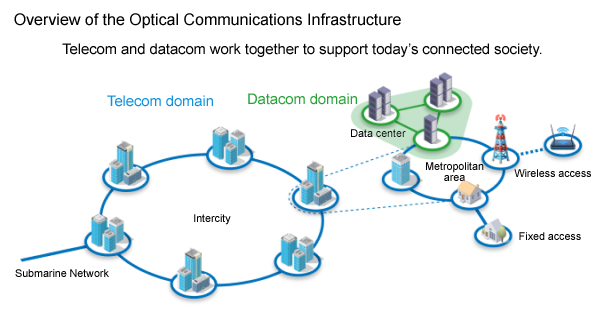
Although these two domains are both physically connected by optical fibers, they fall under clearly separate jurisdictions depending on the service provider. In Japan, the telecom domain is managed by communications carriers such as NTT, while in the United States it is managed by carriers such as Verizon. By contrast, data centers are operated by major CSPs (Cloud Service Providers), including Google, AWS, Meta, and Microsoft.
Devices that perform switching and routing are installed at the boundary between the two domains. These devices switch between security domains and convert signal formats. The data used in our everyday communications is exchanged through this complex network.
Why optical transceivers are essential: their role in supporting data center communications
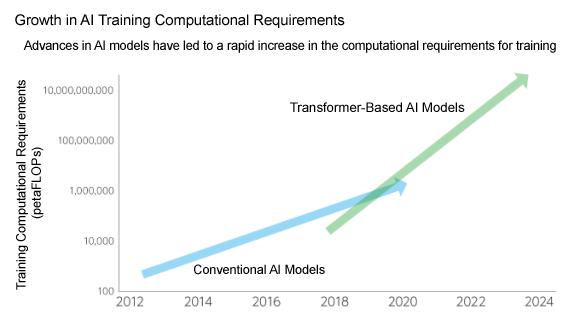
The growth in data traffic in recent years represents a shift on an entirely different scale from the traditional increase in data generated by human activity. The primary driver of this change is AI. Training AI models requires repeated processing of massive datasets, while inference using trained models demands real-time performance. These workloads require computational resources that are orders of magnitude greater than those needed for conventional data consumption.
Data centers contain tens of thousands of enclosures known as racks, each housing multiple server boards. While the performance of the CPUs, GPUs, and TPUs deployed in the servers is critical, the data communication speed between server boards and between racks is equally important in determining the overall processing performance of the AI data center.
To transmit vast volumes of data at high speed between server boards and between racks, optical communication is essential. When electrical signals travel over distances of several tens of centimeters or more on a circuit board, signal degradation and power consumption become significant issues. As a result, optical fiber is used for communication even between server boards within the same server rack. The device that performs the critical function of converting electrical signals into optical signals is the optical transceiver. For a more detailed explanation of the basic structure and operating principles of optical transceivers, see the article below.
Optical Transceiver Fundamentals and Recent Trends
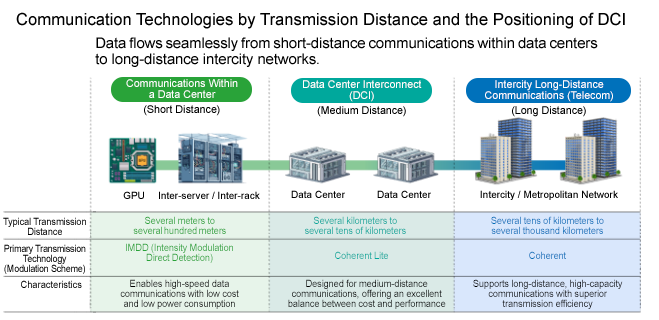
The diagram above illustrates the communication reach (transmission distance) and connected equipment within a data center.
Across all of these layers, optical transceivers are continuing to evolve toward higher speeds. Data center communications are advancing from today’s mainstream 800 Gbps to 1.6 Tbps and eventually 3.2 Tbps. Telecom networks, meanwhile, provide high-capacity, long-distance communications between cities and countries. In recent years, the growing demand for AI has also accelerated the need for higher-speed data center interconnect (DCI) communications.
The factors driving the growing demand for DCI (Data Center Interconnect)
One reason for the growing demand for higher-speed communication between data centers is that hyperscalers have increasingly adopted geographically distributed data center architectures in recent years. The purpose of this distributed deployment is to ensure business continuity. Companies that provide global cloud services distribute their data centers across multiple locations so they can secure the enormous amounts of power they require and continue providing services even if an individual data center becomes unavailable due to a large-scale power outage, fire, natural disaster, or other disruption.
Another recent trend is the emergence of “Scale Across” architectures, in which faster DCI links enable geographically separated data centers to communicate with low latency and bandwidth comparable to those of a single data center. This allows multiple facilities physically distributed away from each other to operate as a unified distributed data center system. As a result, demand for high-speed communication between data centers continues to grow.
Technical requirements for DCI
DCI is typically deployed over distances of approximately 10 to 80 km, connecting multiple data centers within metropolitan areas. As a result, DCI is also one of the key application areas attracting attention for coherent optical communication technology, which is explained in a separate article.
The rapidly growing optical transceiver market in the AI era and future outlooks
As explained throughout this article, equipment used in telecom networks, data center interconnects, and communications within data centers is connected by optical fiber cables. Optical transceivers are installed at the ends of every connection. At the transmitting end (Tx), an optical transceiver converts electrical signals into optical signals for transmission. At the receiving end (Rx), it converts the incoming optical signals back into electrical signals. This bidirectional electrical-to-optical and optical-to-electrical conversion enables high-speed data transmission over long distances. The optical transceiver market is expanding rapidly, particularly in the data center segment. Driven by growing AI demand, the Ethernet transceiver market continues to expand rapidly, with transmission speeds expected to increase further to 1.6 Tbps and 3.2 Tbps.
For a detailed explanation of the differences between bps, bps/lane, and Baud Rate, which underpin advances in optical transceiver speeds, as well as the technical challenges of the 400 Gbps/lane era, see the article below.
How Is Optical Transceiver Communication Performance Determined? An Explanation of bps, bps/lane, and Baud Rate
Related articles



Dexerials is a materials manufacturer that produces materials essential for the evolution of devices and next-generation solutions.
We will create new value with partners around the world in areas including electronic components, bonding materials, and optical materials.
- Share

We provide materials on our products and manufacturing technologies.
They can be downloaded for free.
Download MaterialsRelated Products
Related articles
Photonics Popular Articles









We provide materials on our products and manufacturing technologies.
They can be downloaded for free.
Download Materials