The Frontline of Coherent Lite Systems and PIC Technology
  • Optical Semiconductor Products

The 1.6T / 3.2T Era Begins: Coherent Lite Technology for Datacom and PIC Developments

  • このエントリーをはてなブックマークに追加

PIC Technology Accelerating the Coherent Lite Systems in the 1.6T/3.2T era

In optical communications, Digital Coherent communication systems (hereinafter referred to as Digital Coherent), which offer low signal loss, have traditionally been used in the Telecom field for long-distance transmissions. In contrast, the Datacom field, which focuses on short-distance optical communication, has mainly adopted IMDD communication systems (hereinafter referred to as IMDD systems) because they can be implemented at relatively low cost. However, as data centers continue to expand in scale and increase in speed, signal loss has become an issue. To address this challenge, a technology known as Coherent Lite systems, which apply Digital Coherent systems to datacom applications, has been attracting attention.

In this article, we first walk you through Coherent systems. We then discuss why Coherent Lite systems are needed for datacom applications and introduce the technology of Photonic Integrated Circuits (PICs), which are key devices that enable these systems.

What Is Digital Coherent Signal Modulation, and Why Are Limitations Emerging in the 1.6T Era?

In optical communications, signal modulation methods can be broadly categorized into two types: IMDD systems and Digital Coherent systems. IMDD systems mainly use a signal processing method called PAM4 (4-level pulse amplitude modulation). This method represents data by dividing the intensity of light signals into four levels. Because of its simple structure, IMDD can be implemented at relatively low cost.

However, as hyperscalers such as Google and AWS continue to expand their data center servers, inter-rack connection distances have increased from several meters to approximately 2 km. As a result of this expansion, distances of around 2 to 10 km, which were previously considered data center interconnect (DCI), are increasingly being treated as intra-data-center communication today. Under these distance conditions, and because higher-speed signals are more susceptible to degradation, conventional IMDD systems are becoming insufficient for transmission speeds of 1.6T and above, especially over distances longer than LR.

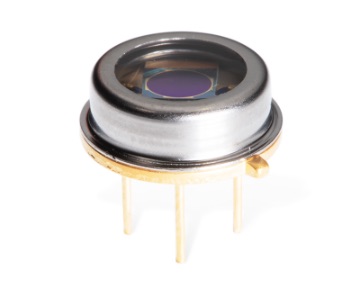
In contrast, Digital Coherent systems use an advanced modulation technology called 16QAM (16-level quadrature amplitude modulation). This method modulates light using its phase, amplitude, and polarization, allowing far more information to be carried in a single signal than with IMDD systems. As a result, Digital Coherent systems achieve lower signal loss over long distances. In Digital Coherent systems, the performance of the modulators that precisely modulate an external light source and the Photodetectors that receive the signal is particularly important.

At even higher speeds, such as 3.2 Tbps, signal loss becomes too large for IMDD systems to handle for long reach. It is therefore expected that Digital Coherent systems will also be adopted for Datacom LR (DCI) applications. Digital Coherent systems applied in the datacom domain are generally referred to as Coherent Lite systems.

To illustrate the difference between these two methods, IMDD systems, which transmit information using only light intensity, can be compared to Morse code. Digital Coherent systems, which use phase and polarization in addition to intensity, are more like music, conveying richer information through melody and rhythm as well as volume.

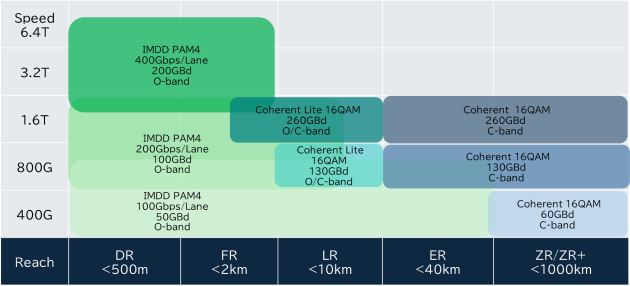
The figure below summarizes the applicable ranges of IMDD systems, Coherent Lite systems, and Digital Coherent systems in terms of transmission speed and distance. As communication speeds increase and transmission distances get longer, the preferred communication system will shift accordingly.

The 1.6T LR specification is sometimes referred to as “1.6T CL” as an interim designation because it covers not only 2 km(LR) Reach but also more longer distances. It is expected to be formally standardized in 2027, and this technology is widely regarded as the leading approach within the communications industry.

What Is This PIC Technology That Accelerating the 1.6T / 3.2T Era?

Dexerials is developing PICs for the Digital Coherent systems and Coherent Lite communication systems described above. In this section, we explain the PIC technologies that are currently attracting attention and introduce the synergy with high-speed InP photodiodes, which are one of Dexerials’ core strengths.

Photonic Integrated Circuit (PIC) technology is a new approach that integrates multiple functional optical components on a single wafer using silicon processes. Until now, optical transceivers required precise assembly and alignment of multiple optical components, such as lasers, lenses, modulators, filters, and photodetectors. These assembly processes demanded sub-micron alignment accuracy and were beginning to reach their limits in terms of yield, reliability, and manufacturing throughput. PICs address these challenges by forming the main optical functions of an optical transceiver directly on a silicon wafer. This allows the key functions of an optical transceiver to be integrated all at once using semiconductor manufacturing processes.

In addition, by outsourcing production to foundries with strong expertise in silicon processes, such as TSMC, business expansion becomes possible without large-scale capital investment in manufacturing facilities. From the perspectives of higher performance, improved reliability, lower cost, and mass production, PICs are expected to replace conventional discrete assembly.

Five Key Functions of PICs

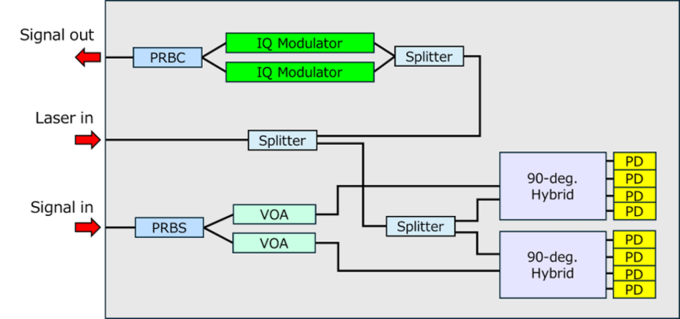
For PICs used in Coherent Lite systems, how these functions are combined is a critical consideration when determining the implementation architecture. PICs for Digital Coherent systems mainly incorporate the following five key functions.

PIC-Integrated Device Functions Role
Optical Waveguides Interconnections that guide light to the required functions
Passive Components Splitters / Combiners Separate or combine light as it propagates
Polarization Demultiplexing (PRBS, PRBC)
90° Hybrid Separate orthogonal phase components of optical signals
Modulators
Interferometric (Mach-Zehnder) type (IQ modulator) Impart phase and amplitude changes to laser light to generate the desired transmitted signal
Variable Optical Attenuator (VOA) Adjust optical power levels
Photodetectors Convert optical signals into electrical signals

Key Technology Areas Dexerials Focuses on for Coherent PIC Development

In recent years, the adoption of PIC technology in datacom optical transceivers has been rapidly driven by cost reductions. Looking ahead, PICs for next-generation Coherent systems are expected to integrate optical waveguides, modulators, and photodetectors within a single architecture. Based on this assumption, Dexerials is developing PIC products for integrated transmitter-receiver (TRx) applications.

Leveraging our expertise in designing high-speed indium phosphide (InP) photodiodes, we are also exploring functional expansion by heterogeneously integrating next-generation waveguide photodiodes compatible with 260 GBd onto PICs. Below is a conceptual illustration of a TRx-integrated PIC designed for Coherent systems.

* The yellow sections indicate waveguide photodiodes. We are developing both PICs with SiGe photodiodes mounted on the PIC and PICs with heterogeneously integrated InP photodiodes.

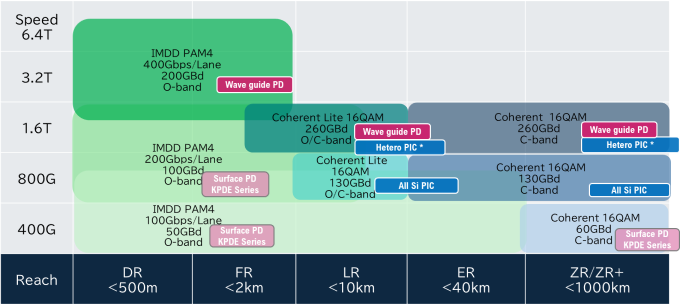
In response to changes in communication systems and implementation requirements, Dexerials offers PIC-related products optimized for different applications and transmission distances.

* Hetero PIC: PICs that apply heterogeneous integration technology

In response to the expanding market for Digital Coherent and Coherent Lite systems, Dexerials is combining its long-established compound semiconductor design technologies, including InP, with silicon photonics technologies to advance the development of PICs.

We also conduct feasibility studies on PIC configurations and applications for Coherent systems based on individual technical requirements. If you are interested, please feel free to contact us.

Contact us
Dexerials

Dexerials is a materials manufacturer that produces materials essential for the evolution of devices and next-generation solutions.

We will create new value with partners around the world in areas including electronic components, bonding materials, and optical materials.

View all products

We provide materials on our products and manufacturing technologies.

They can be downloaded for free.

Download Materials

We provide materials on our products and manufacturing technologies.

They can be downloaded for free.

Download Materials

Related Items