

- Optical Semiconductor Products
How Is Optical Transceiver Communication Performance Determined? An Explanation of bps, bps/lane, and Baud Rate

Optical transceivers use a variety of metrics to describe communication performance, such as 800 Gbps, 200 Gbps/lane, and 100 Gbaud. Specifically, these represent the overall communication speed of the transceiver, the communication speed per lane, and signal switching rate, respectively. This article explains bps, bps/lane, and Baud Rate, as well as the factors driving the increasing speed of optical transceivers.
目次
- 1. Understanding optical transceiver performance: what are the three key metrics—bps, bps/lane, and Baud Rate?
- 2. Background to the demand for 200 Gbps/lane in data center optical transceivers
- 3. The challenges to achieving 400 Gbps/lane technology
- 4. Next-generation photodiodes required for 400 Gbps/lane
Understanding optical transceiver performance: what are the three key metrics—bps, bps/lane, and Baud Rate?
For data communications optical transceivers, the relationship between bps, bps/lane, and Baud Rate determines the required number of optical fibers and the transceiver configuration. The table below summarizes the relationship among these metrics, assuming the simplest single-mode configuration in which each optical fiber carries a single wavelength (one communication lane per optical fiber). *Note: The Baud Rate values are theoretical values based on the PAM4 modulation format. (Refer to the later section for details.)
| Transceiver speed | bps/lane | Number of optical fibers (number of lanes) | Baud Rate |
|---|---|---|---|
| 800 Gbps | 100 Gbps/lane | 8 | 50 Gbaud |
| 200 Gbps/lane | 4 | 100 Gbaud | |
| 1.6 Tbps | 200 Gbps/lane | 8 | 100 Gbaud |
| 400 Gbps/lane | 4 | 200 Gbaud | |
| 3.2 Tbps | 400 Gbps/lane | 8 | 200 Gbaud |
For the same transceiver speed (bps), increasing bps/lane makes it possible to reduce the number of optical fibers used. Conversely, configurations with a lower bps/lane require more optical fibers and are therefore less advantageous in terms of mounting area and power consumption. To understand these differences, this section first examines the relationship among bps, bps/lane, and Baud Rate.
(1) What does the communication speed (bps) of an optical transceiver represent?
Bits per second (bps) is a speed metric that indicates the overall communication capacity of an optical transceiver. It represents the amount of data that can be transmitted and received in 1 second. In optical transceiver specifications, it is used to indicate the overall communication speed of the product. Common values for current products include 400 Gbps and 800 Gbps, while next-generation products support 1.6 Tbps and even 3.2 Tbps. At present, 800 Gbps is the mainstream communication speed for data center applications, and mass production of 1.6 Tbps products has also begun.
(2) Why bps/lane makes a difference even at the same bps
A lane is an independent signal path used in parallel transmission and can be thought of as a single channel through which data flows. Accordingly, bps/lane indicates the data transfer rate of a single signal path. In modern optical transceivers, increasing bps/lane is key to smaller form factors, lower power consumption, and higher transmission speeds.
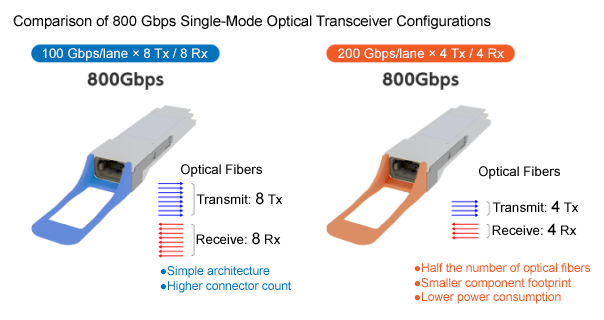
Currently, single-wavelength 800 Gbps optical transceivers generally use one of two configurations. One uses eight lanes operating at 100 Gbps/lane, while the other uses four lanes operating at 200 Gbps/lane. Here, the number of lanes refers to the number of signal channels, and therefore the number of optical fibers either transmitting or receiving data. Although both configurations provide an overall transceiver communication speed of 800 Gbps, their internal architectures differ significantly. The 200 Gbps/lane configuration halves the number of required lanes on both the transmit and receive sides. This reduces the component footprint and contributes to lower power consumption. But as the configuration must handle higher-speed signals, its waveforms are more susceptible to distortion caused by signal degradation and noise. It therefore requires advanced signal processing and high-performance transmitter and receiver devices, making it more technically challenging.
(3) The relationship between Baud Rate and bps/lane
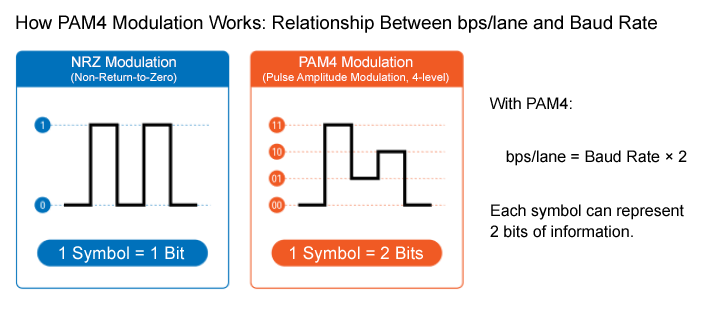
The Baud Rate (unit: Bd) indicates the number of signal states (symbols) transmitted per second. In optical communications for data communication applications, conventional systems have generally used intensity-modulation direct-detection (IMDD) schemes that transmit 1 bit per symbol. In recent years, however, the PAM4 modulation format, which can transmit 2 bits per symbol, has also been adopted. As noted above, a symbol is a unit representing a signal state. Because PAM4 uses four distinct signal levels (states), each symbol can carry 2 bits of information. The following relationship therefore applies to PAM4.
bps/lane = Baud Rate × 2
For example, when PAM4 modulation is used, a Baud Rate of 200 Gbaud enables transmission at 400 Gbps/lane.
Having explained the three key metrics—bps, bps/lane, and Baud Rate—let us look more closely at the communication performance of optical transceivers based on these metrics.
Background to the demand for 200 Gbps/lane in data center optical transceivers
Optical transceivers for data centers have long been based primarily on 100 Gbps/lane configurations. With the transition to the 800 Gbps generation, however, the number of required optical fibers has increased, bringing challenges such as larger transceiver form factors and higher power consumption to the forefront. Against this backdrop, demand has grown for 200 Gbps/lane technology, which enables high-speed communication using fewer optical fibers. Achieving this requires improved performance across the various devices that make up an optical transceiver, including laser sources, photodiodes (PDs), and digital signal processors (DSPs).
Currently, 200 Gbps/lane technology is steadily advancing and is increasingly being adopted in 800 Gbps and 1.6 Tbps optical transceivers. Looking ahead, next-generation 3.2 Tbps optical transceivers are expected to require even faster 400 Gbps/lane technology.
The challenges to achieving 400 Gbps/lane technology
If 400 Gbps/lane technology, an evolution of 200 Gbps/lane technology, can be realized, it will enable even higher-capacity communications of 1.6 Tbps or 3.2 Tbps while keeping the number of lanes per transceiver to a minimum. However, its realization involves technical hurdles that are far greater than ever before.
In particular, 400 Gbps/lane technology demands usability over a wider bandwidth and faster response characteristics than existing solutions. However, devices based on conventional silicon materials are beginning to approach the limits of their response speed and frequency performance in these ultra-high-speed operating regimes. As a result, there is active development on new device technologies based on compound semiconductors, such as indium phosphide (InP), which are better suited for ultra-high-speed operation.
Next-generation photodiodes required for 400 Gbps/lane
Increasing the speed of optical transceivers for data centers requires advances in both transmitter and receiver-side devices. This includes further development of photodiodes, which are key components in receivers. Conventional surface-illuminated PIN photodiodes have supported data rates of up to 100 Gbps/lane and 200 Gbps/lane, but are becoming increasingly difficult to use with ultra-high-speed signals in the 400 Gbps/lane class. In addition, the ability to accurately detect weak optical signals and measures to address heat generation during high-speed operation have become important challenges.
Addressing these challenges requires advances not only in materials but also the structure of the photodiode itself. At Dexerials, in addition to high-speed-response photodiodes using indium phosphide (InP) and gallium arsenide (GaAs), research and development is underway on waveguide photodiodes, which have a structure different from that of conventional devices.
For more information on how waveguide photodiodes work, see this article.
The following article provides a detailed explanation of Coherent Lite and photonic integrated circuit (PIC) technologies, both of which are expected to play a key role in the 400 Gbps/lane era.
The 1.6 T / 3.2 T Era Begins: Coherent Lite Technology for Datacom and PIC Developments
Related articles



Dexerials is a materials manufacturer that produces materials essential for the evolution of devices and next-generation solutions.
We will create new value with partners around the world in areas including electronic components, bonding materials, and optical materials.
- Share

We provide materials on our products and manufacturing technologies.
They can be downloaded for free.
Download MaterialsRelated Products
Related articles
Photonics Popular Articles













We provide materials on our products and manufacturing technologies.
They can be downloaded for free.
Download Materials