
- Optical Semiconductor Products
What Is the Role of Photodiodes in Pulse Oximeters?—Mechanism, Selection Criteria, and Wearable Applications Explained

The novel coronavirus disease (COVID-19), which impacted the world for more than three years starting in late 2019, led to widespread use of certain medical devices for patient monitoring. One such device is the pulse oximeter. During the pandemic, some individuals may have received a pulse oximeter on loan from local municipalities while recovering at home.
目次
- 1. How Pulse Oximeters Work and Principles of Oxygen Saturation Measurement
- 2. Basic Principles of Pulse Oximeters—The Relationship Between Light and Photodiodes
- 3. Role and Selection Criteria for Photodiodes in Pulse Oximeters
- 4. Dexerials' Optoelectronic Technologies—LED Modules and Photodiode Products
- 5. The Importance of Pulse Oximeters Highlighted During the COVID-19 Pandemic
- 6. The Future of the Pulse Oximeter Market—Wearable Devices and Advances in Optoelectronics
How Pulse Oximeters Work and Principles of Oxygen Saturation Measurement
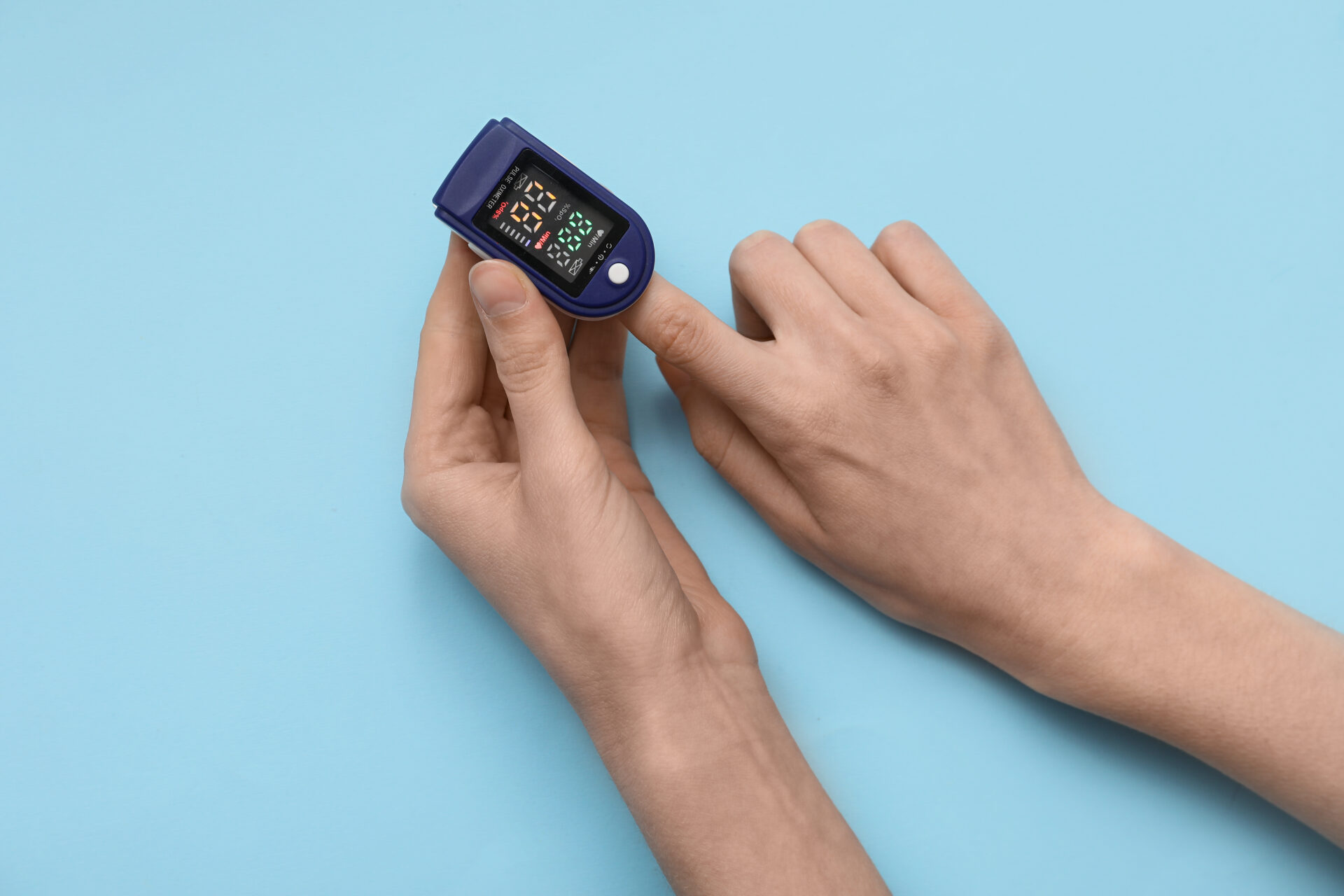
Pulse oximeters are among the most widely used diagnostic devices in medical and healthcare settings. A clip-like probe is placed on the fingertip to estimate the state of hemoglobin and its oxygen binding based on differences in light absorption. From these measurements, the device calculates and displays oxygen saturation (SpO₂), which indicates the percentage of oxygen in arterial blood, along with pulse rate.
Measuring oxygen saturation is an important indicator for assessing whether sufficient oxygen is being delivered to organs and tissues throughout the body. Since it can be measured noninvasively, by attaching the device to a fingertip or earlobe, pulse oximetry offers a high level of convenience. As a result, its use has expanded beyond homes and hospitals to include home healthcare, emergency settings, and wearable devices
In hospitals, pulse oximeters are used to check vital signs in emergency patients, such as those involved in accidents, as well as in patients experiencing rapid deterioration. During surgery, pulse oximeters continuously monitor a patient's blood oxygen saturation to ensure that the oxygen supply required to sustain life is maintained at all times. Pulse oximeters are also used for inpatients and outpatients as part of routine examinations. In particular, individuals with respiratory or cardiovascular conditions, older adults, and smokers are more prone to decreased oxygen saturation, so regular monitoring is recommended. In addition, pulse oximeters are useful for screening sleep apnea and for managing physical condition at high altitudes.

A key component that enables pulse oximeters, essential for medical diagnostics, to measure blood oxygen saturation with high accuracy is the photodiode, a type of optoelectronic semiconductor.
Basic Principles of Pulse Oximeters—The Relationship Between Light and Photodiodes
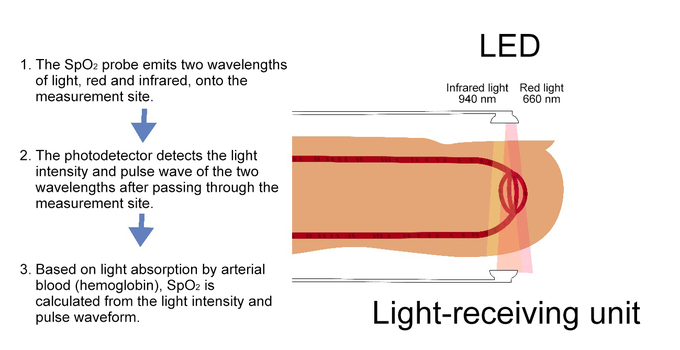
Pulse oximeters emit two types of light from a compact housing toward the fingertip and analyze the light transmitted through tissue to determine blood oxygen levels. Specifically, they use visible red light (approximately 660 nm) and near-infrared light (approximately 940 nm), which is not visible to the human eye.
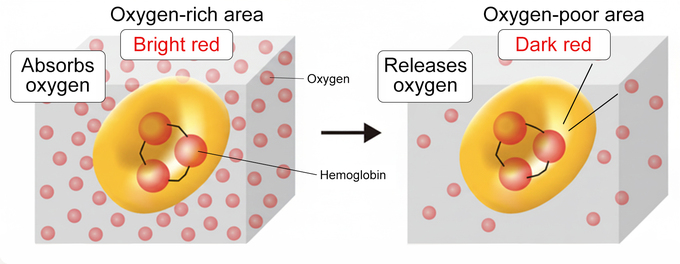
Hemoglobin, a protein in red blood cells, is responsible for carrying oxygen in the blood. There are two types of hemoglobin: oxygenated hemoglobin, which is bound to oxygen, and deoxygenated hemoglobin, which has released oxygen. Each type absorbs light at different wavelengths. A pulse oximeter directs two types of light onto the fingertip and measures how much light is absorbed and transmitted. Based on differences in light transmittance, it accurately calculates the proportion of oxygen in the blood, or SpO₂. LEDs are used to emit the light, and a photodiode, a type of optoelectronic semiconductor, detects the transmitted light. By precisely capturing light intensity, the photodiode enables reliable measurement results.
Role and Selection Criteria for Photodiodes in Pulse Oximeters
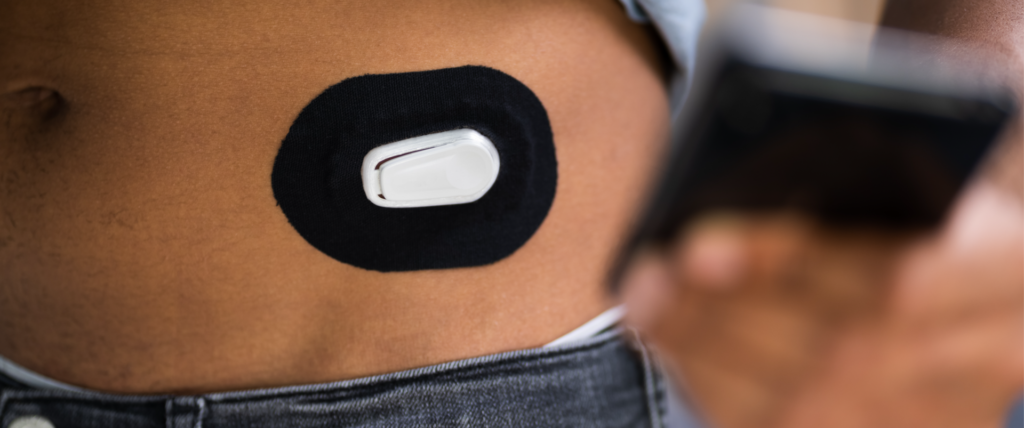
In the sensor section of a pulse oximeter, red light at 660 nm and near-infrared light at 940 nm emitted from LEDs pass through the fingertip, and the transmitted light is detected by a photodiode. In wearable devices such as smartwatches, transmission-based measurement at the fingertip is not feasible, so measurements are performed using reflected light at other locations such as the wrist. The photodiode is not just a photodetector. It is a core component that directly affects measurement accuracy. The following characteristics are required for photodiodes used in pulse oximeters.
- Spectral Sensitivity: High sensitivity at both wavelengths near 660 nm and 940 nm.
- Low Dark Current: Minimizing noise (dark current) when no light is present, enabling accurate detection of weak optical signals.
- High S/N Ratio: Clearly detect weak light transmitted through the body and provide output suitable for signal processing.
- Response Speed: Provide sufficient responsiveness to track pulse waveforms in real time.
- Compact Size and Low Power Consumption: Enable space-saving design and long operating time suitable for wearable device applications.
Selecting a photodiode that meets these requirements is a key consideration for design engineers.
Dexerials' Optoelectronic Technologies—LED Modules and Photodiode Products
We provide LED modules as light sources and a range of photodiodes for pulse oximeters.
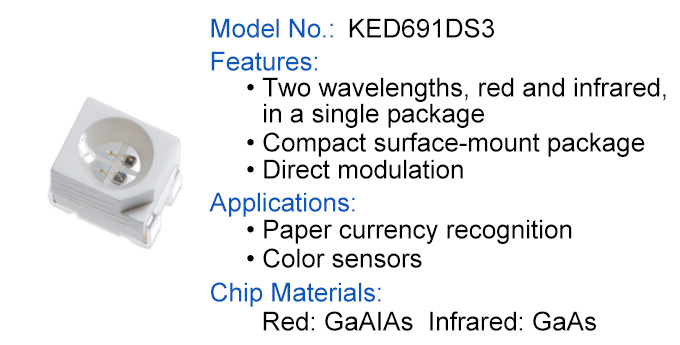
KED691DS3 Dual-Wavelength LED Module
This is a compact surface-mount LED module (3.5 mm x 2.7 mm) that integrates two LEDs, 660 nm red light and 940 nm near-infrared light, into a single package. It enables compact integration of the two wavelengths required for pulse oximeters.
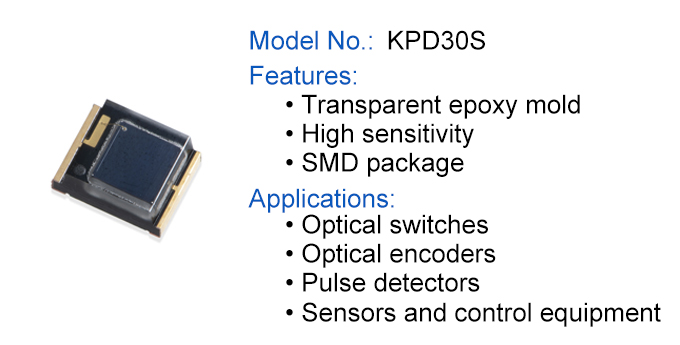
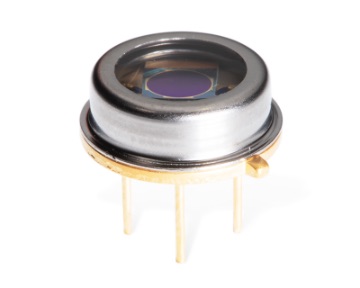
KPD30S Silicon Photodiode
This is a large-area photodiode that covers a detection wavelength range of 400 to 1,100 nm, making it well suited for transmission-type sensors in pulse oximeters. Its wide light-receiving area efficiently captures weak light transmitted through the fingertip.
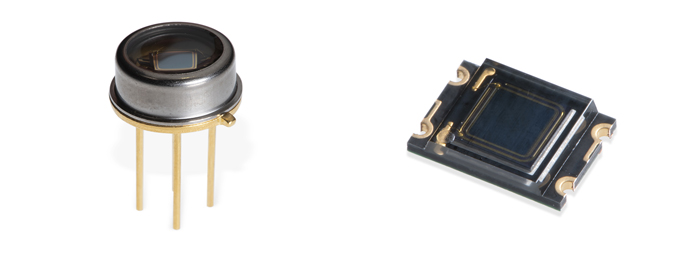
Dual-Wavelength Photodiode
This photodiode is optimized for the two wavelengths 660 nm and 940 nm, contributing to improved measurement accuracy in pulse oximeters.
The Importance of Pulse Oximeters Highlighted During the COVID-19 Pandemic
During the COVID-19 pandemic that continued for several years from 2020, many patients experienced a condition known as silent hypoxia, or asymptomatic hypoxemia, due to reduced respiratory function. Silent hypoxia refers to a state in which blood oxygen levels drop to dangerous levels without noticeable symptoms such as shortness of breath. Even in the absence of symptoms, prolonged low oxygen levels place stress on organs and pose a risk of serious damage, particularly to the brain and heart. For this reason, monitoring blood oxygen saturation became critical. The use of pulse oximeters enables early detection of abnormalities and supports timely medical intervention. This is why pulse oximeter testing became widely adopted in households during the pandemic, leading to a rapid increase in global demand.
The Future of the Pulse Oximeter Market—Wearable Devices and Advances in Optoelectronics
Although the surge in demand during the COVID-19 pandemic has stabilized, the pulse oximeter market is expected to continue to grow steadily. As populations continue to age, demand for home healthcare and telemedicine is increasing, raising the importance of pulse oximeters as tools for daily health monitoring. Another key trend is the integration of pulse oximeter functions into wearable devices such as smartwatches and fitness trackers. Many wearable devices, including smartwatches that hold a significant share of the market, already incorporate blood oxygen saturation measurement. Continuous 24-hour monitoring is making continuous health monitoring more accessible. As wearable applications expand, three key priorities in product development are miniaturization, low power consumption, and high accuracy. In particular, battery-powered wearable devices require power-efficient design to enable long operating times. At the same time, maintaining high accuracy in measurements at locations such as the wrist requires higher-sensitivity photodiodes and more efficient signal processing technologies.
Dexerials is advancing product development to meet these market needs through innovation in optoelectronic semiconductor technologies, contributing to further advances in medical and healthcare technologies.
Related articles


Dexerials is a materials manufacturer that produces materials essential for the evolution of devices and next-generation solutions.
We will create new value with partners around the world in areas including electronic components, bonding materials, and optical materials.
- Share
We provide materials on our products and manufacturing technologies.
They can be downloaded for free.
Download MaterialsRelated Products
Related articles
Photonics Popular Articles







We provide materials on our products and manufacturing technologies.
They can be downloaded for free.
Download Materials