

- Optical Products
Personal Protective Equipment (PPE) for Infection Control in the Operating Room: Types, Characteristics, and the Evolution of Face Shields

[Medical Content Disclaimer]
The content of this article is provided for general technical information and an overview of market trends. It is not intended to recommend or endorse any specific medical procedure, treatment, diagnosis, or prescription.
The information presented here is offered as a reference for healthcare professionals and medical device industry personnel. It is not intended for medical decision-making or use by general consumers.
Products, materials, and technologies described in this article may not necessarily be certified or approved as medical devices under applicable regulations, including the Pharmaceutical and Medical Device Act in Japan. Please confirm the relevant regulatory requirements and approval status in each country or region before actual use. The content is based on information available at the time of writing and may be subject to change without notice.
This disclaimer applies specifically to healthcare-related articles on TECHTIMES and is independent of the general “Disclaimer of Warranties” applicable to the website as a whole.
目次
- 1. What is PPE?
- 2. Types of PPE Used in the Operating Room and Their Applications
- 3. High Visibility Face Shields with Dexerials’ micro fabrication technology
- 4. Core of Dexerials’ Microfabrication technology
- 5. Evolution of PPE to Meet the Needs of Medical Environments: Balancing High Visibility and Safety
What is PPE?
Personal Protective Equipment (PPE) is essential for the safety of healthcare workers, particularly those working in the operating theatre. In this article, we explain the different types of PPE used in the operating theatre and their role in preventing infection.
Types of PPE Used in the Operating Room and Their Applications
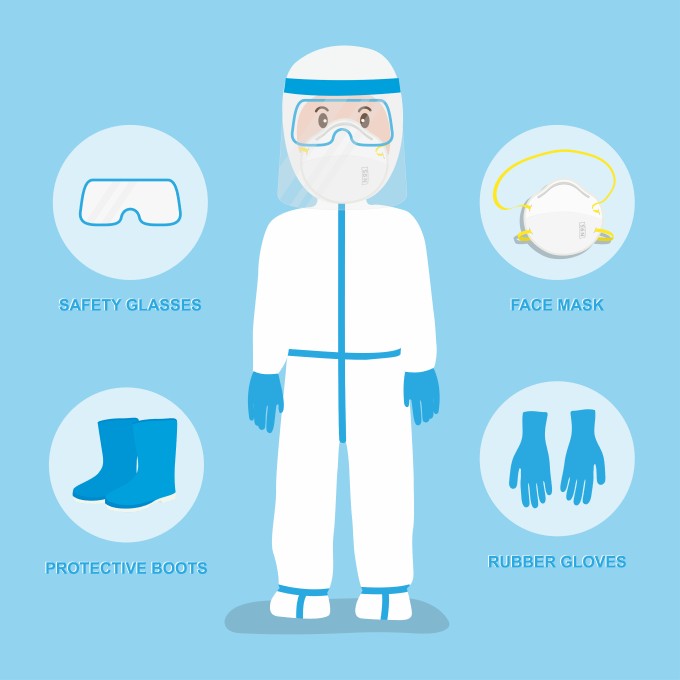
There are several types of PPE used in the operating room, each serving a different role. The following table summarizes representative types of PPE and their characteristics.
| PPE Type | Description |
|---|---|
| Surgical Gowns | Surgical gowns are an important piece of PPE in the operating room, protecting both the wearer and the patient from contamination. They should be worn over sterile surgical gowns and changed after each procedure. |
| Surgical Masks | Surgical masks are designed to protect the wearer from droplets, splashes and sprays that may contain infectious agents. They should be changed between patients or when they become damp. |
| Face Shields | Face shields provide additional protection for the face and eyes and are often worn in addition to masks. They are particularly important during procedures that may result in splashes or sprays of body fluids. |
| Gloves | Gloves are an essential component of surgical PPE, providing a barrier between the hands and the patient. They should be changed between patients and never reused. |
| Hair covers | Hair covers are important to prevent the shedding of hair and skin particles that can harbour bacteria and other pathogens. They should be worn by all members of the surgical team and changed after each procedure. |
| Shoe covers | Shoe covers are worn to prevent the spread of micro-organisms that may be present on shoes. They should be worn in all surgical areas and changed between patients. |
| Respirators | Respirators, such as N95 masks, are recommended for procedures that may generate aerosols, such as intubation. They are designed to filter out small particles and provide a higher level of protection than surgical masks. |
High Visibility Face Shields with Dexerials’ micro fabrication technology
Clear visibility is essential in surgical environments. In particular, reduced work accuracy caused by reflections and visual distortion can directly affect patient safety.
High Visibility Face Shields using Dexerials' Moth-eye film are a type of Personal Protective Equipment (PPE) that provides improved visibility for healthcare workers in surgical environments.
(For more information on the Moth-eye type anti-reflective film, please refer to the related article.)

These face shields are designed to reduce glare and reflections that can cause visual distortion, making it easier for healthcare workers to see and perform their tasks with greater accuracy and efficiency. The moth-eye film used in these face shields incorporates micro-fabrication that reduces the amount of light reflected from the surface of the shield, helping to improve clarity while reducing eye strain and fatigue. In addition to improved visibility, high visibility face shields offer the same level of protection as traditional face shields. They are made of clear plastic or other transparent materials and are designed to cover the entire face from forehead to chin. Some models can also cover the sides of the face for additional protection. As with other types of PPE, face shields should be cleaned and disinfected after each use in accordance with hospital protocols and are typically disposed of after surgery. They should be replaced promptly if damage or deterioration is observed.
Core of Dexerials’ Microfabrication technology
At the core of the anti-reflective moth-eye film used in high-visibility face shields is Dexerials’ microfabrication technology. This technology forms Fine surface structures ranging from several hundred nanometers to several hundred micrometers by carving the surface of base materials such as film, resin sheets, and glass, or stacking materials onto these surfaces, thereby adding functions such as the control of light reflection.
This microfabrication process is supported by Dexerials’ proprietary roll-to-roll transfer technology.
The “roll-to-roll method” is a production method in which base materials such as films, wound in lengths of several hundred meters, are continuously supplied, processed, and collected. Compared with conventional batch processing, in which substrates are processed individually in flat units, the roll-to-roll method enables continuous processing of long materials, making highly efficient mass production possible.

Imprint technology is a technology that transfers a shape by pressing a "mold" onto a soft resin or other material.
In the image below, resin is pressed against the mold to transfer the shape.
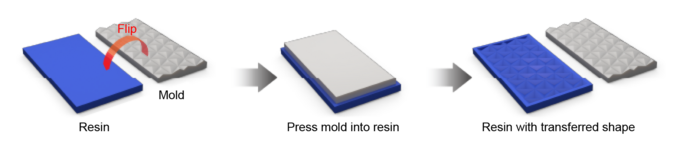
In imprint technology, a shape is transferred by pressing a mold into a resin layer formed on the surface of a base material. By bringing the mold into contact with the resin and applying pressure, the micro-scale pattern of the mold is physically transferred to the resin surface.
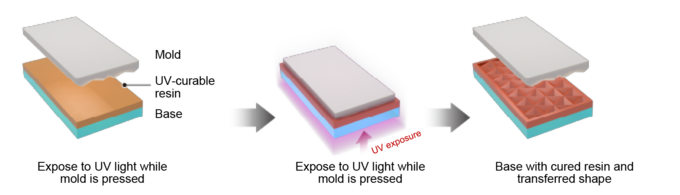
In UV imprinting, which uses ultraviolet (UV) light, UV-curable resin is applied to the base material, and the mold is pressed against the resin while it is exposed to UV light.
The resin hardens upon UV exposure, and when the mold is removed after curing, the inverse shape of the mold is formed and fixed on the surface of the base material.
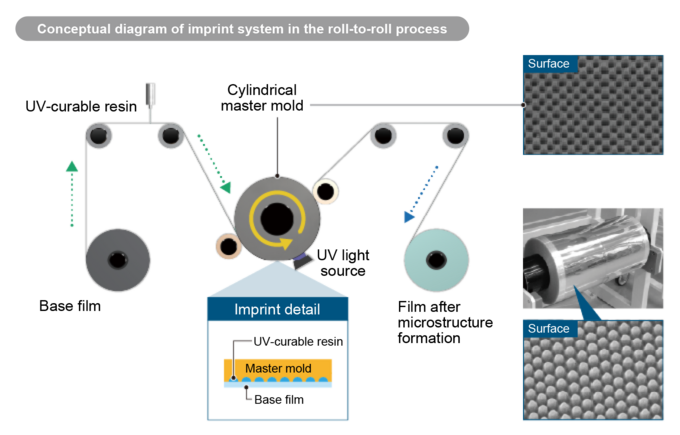
In roll-to-roll UV imprinting, UV-curable resin is first applied to the surface of the base film supplied from a roll. As the film passes through the cylindrical master mold, the resin-coated surface is brought into contact with the mold, and ultraviolet (UV) light is simultaneously irradiated to cure the resin. After curing, the microstructure pattern formed on the master mold is transferred onto the film surface, and the processed film is then rewound as a finished product.

In this process, the master substrate is treated with a mold release process so that the cured resin can be cleanly released from the mold. In order to realize this roll-to-roll imprinting technology, a wide range of factors must be strictly controlled, including the following:
- High-precision microfabrication technology for cylindrical masters
- Humidity and temperature control inside the equipment
- Control of UV illumination
- Precise roll running control
- Uniform control of resin thickness, composition, and viscosity
Dexerials leverages many years of expertise in roll-to-roll imprinting technology to achieve stable processing quality and high mass productivity. (For more details on roll-to-roll imprinting technology, please refer to the related article the related article.)
Evolution of PPE to Meet the Needs of Medical Environments: Balancing High Visibility and Safety
Personal protective equipment (PPE) plays an essential role in medical environments by helping to prevent the spread of infectious diseases and protecting healthcare workers during daily clinical procedures. In particular, PPE such as face shields is widely used as a barrier against droplets and other hazards in operating rooms and treatment areas.
In surgical environments, however, PPE is required not only to provide protection but also to ensure clear and stable visibility. Surgeons and medical staff must perform highly precise tasks, and even slight visual disturbances can affect their ability to work accurately.
Reflections from the surface of face shields and optical distortion caused by protective materials can reduce visibility and lead to visual fatigue during prolonged procedures. Addressing these issues has become an important requirement in the evolution of PPE designed for use in operating rooms.
Related articles




Dexerials are a materials manufacturer that produces materials essential for the evolution of devices and next-generation solutions.
We will create new value with partners around the world in areas including electronic components, bonding materials, and optical materials.
- Share
We provide materials on our products and manufacturing technologies.
They can be downloaded for free.
Download MaterialsRelated Products
Related articles
Popular articles related to optics












We provide materials on our products and manufacturing technologies.
They can be downloaded for free.
Download Materials