

- Elemental Technologies
Sulfidation and Nitriding Technologies Paving the Way for Future Material Innovation — Dexerials’ Breakthroughs in Inorganic Materials

目次
- 1. Half a Century of Expertise in Inorganic Material Technology
- 2. Sulfidation and Nitriding Technology— Engineering New Materials to Surpass the Limits of Conventional Inorganic Compounds
- 3. Soaking Properties for New Material Development──Design and Advantages of Gas-flow furnace
- 4. Real-world Applications of Sulfide and Nitride Materials──Development into Phosphors and Photocatalyst Materials
- 5. Industry-Academic Research and Development for Sulfide and Nitride Materials─Seeking Co-creation Partners
- 6. To Researchers and Engineers Interested in Sulfidation and Nitriding Technology
Half a Century of Expertise in Inorganic Material Technology
For more than half a century, Dexerials has been honing inorganic material synthesis technology as one of its core competencies in material development. Based on this technology, we have created numerous innovative products, including ferrite cores for magnetic heads, PZT piezoelectric materials, specialized glass films, cathode materials for lithium-ion batteries, and display phosphors.
Sulfidation and Nitriding Technology— Engineering New Materials to Surpass the Limits of Conventional Inorganic Compounds
As the research world comes ever closer to the performance limits of oxide materials, Dexerials has been actively developing multi-anion materials composed of sulfur and nitrogen to create new functions unattainable with conventional materials.
Multi-anion materials are chemical compounds that incorporate two or more different anions (electronegative or negatively-charged ions), such as oxysulfides and oxynitrides. Traditionally, oxides have been widely applied in ceramics, semiconductors, and catalysts due to their stability and scalability. However, oxide-based materials have reached a high level of maturity, and multi-anion materials are now emerging as a promising alternative capable of surpassing oxides.
For example, conventional photocatalysts for artificial photosynthesis—materials that generate hydrogen energy by decomposing water under sunlight—have typically used ultraviolet light only, even though it is visible light that represents the major fraction of sunlight. In fact, visible and infrared light account for approximately 95% of sunlight in contrast to ultraviolet light, which is a minority. Therefore, making photocatalysts reactive to visible light is essential to improving solar energy utilization. To address this challenge, Dexerials is developing new artificial photosynthesis materials (photocatalysts) by applying sulfidation and nitriding technology to oxide catalysts, thereby harnessing visible light for more efficient artificial photosynthesis.

Material design based on sulfidation and nitriding is a promising approach not only for surpassing the performance limits of existing materials but also for unlocking entirely new functional possibilities.
Developing such state-of-the-art materials requires highly toxic and flammable reactant gases, such as hydrogen sulfide (H₂S) and ammonia (NH₃), so Dexerials has established mass-production facilities capable of handling these high-risk gases safely and stably, while also enabling practical application of these materials to be scaled up.
In addition, to make experimentation easier at the fundamental stage, we are developing equipment that allows flexible and conditional control of reactant gas handling and firing environments. This technical infrastructure serves as a foundation for exploring new inorganic materials.
Soaking Properties for New Material Development──Design and Advantages of Gas-flow furnace
In the synthesis of sulfidation and nitriding materials, both firing temperature control and uniform atmospheric gas distribution have a significant impact on determining material characteristics. This is especially true when working with highly reactive gases, such as hydrogen sulfide and ammonia, that require advanced handling control. In these cases, furnace design directly influences reaction uniformity and safety.
Dexerials owns furnaces optimized for gas-flow methods and their design enables high uniformity of temperature while controlling the flow of reactant gas. These furnaces provide large, evenly heated areas that maintain consistent temperature and atmospheric gas conditions regardless of crucible arrangement. This provides consistent thermal processing across multiple samples and enables highly reproducible synthesis by minimizing variations in material properties.
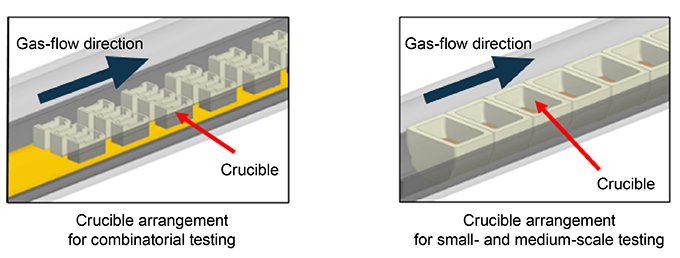
Furthermore, our furnaces are designed to allow highly flexible sample arrangements. For example, they support combinatorial testing—parallel evaluation of different conditions—by accommodating multiple small ceramic containers (crucibles). This makes it possible to simultaneously assess various compositions and firing conditions (see left diagram).
These furnaces also accommodate larger crucibles for bulk synthesis, enabling scaled-up evaluations for subsequent stages (see right diagram).
Dexerials has established an integrated system covering the entire process—from precursor synthesis and firing to post-processing and characterization. This setup enables optimization from early-stage exploration to mass-production conditions within a single facility. It provides valuable research infrastructure for academia and development units that value uniform and reproducible reactions.
Developing new materials through sulfidation and nitriding technology presents the significant challenge of conducting synthesis at high temperatures in the presence of toxic gases. In particular, the process requires handling highly toxic and flammable gases, such as hydrogen sulfide and ammonia, under elevated temperatures, demanding advanced facilities and a sophisticated management system for precise control. Dexerials' facilities are capable of solving these problems, enabling safe and reliable handling of reactant gases at a mass-production scale.
Real-world Applications of Sulfide and Nitride Materials──Development into Phosphors and Photocatalyst Materials
Dexerials' sulfidation and nitriding technology has already yielded several successful outcomes.
Our display phosphor films, released in 2021, utilize sulfide-based green phosphors with high luminance efficiency. Their performance has earned high praise for enabling enhanced image quality and thinner displays.
In addition, we have participated in the Artificial Photosynthetic Chemical Process Technology Research Association (ARPChem) from its second term (2021-2030) and are advancing research and
development toward the realization of artificial photosynthesis.
ARPChem is a research consortium whose goal is to establish artificial photosynthesis chemistry technology that will enable CO₂-free hydrogen production. ARPChem is a collaboration between
companies and research institutions, and is responsible for developing photocatalytic materials. Through the construction of water-splitting equipment and safety evaluations, the consortium
aims to establish technology for the practical application of artificial photosynthesis.
In this project. Dexerials is contributing to boost the efficiency of water splitting and hydrogen production using solar energy, thereby improving the efficiency of sustainable energy conversion.
For more details on this project, please refer to this article.
Development of Technology for Producing Raw Materials for Plastics Using CO2 and Other Sources | NEDO Green Innovation Fund Projects
Industry-Academic Research and Development for Sulfide and Nitride Materials─Seeking Co-creation Partners
To help realize a carbon-neutral society by 2050, Dexerials is currently developing new functional materials that can contribute to applications in the energy sector. We are advancing material design with an eye toward broad applications, such as sunlight-conversion materials and sensors, unlocking new possibilities for sulfide and nitride materials.
In materials development, Dexerials has put in place a system to use its facilities and know-how to work with technology developers to solve issues such as "We want samples with minimal variation in material quality for the pre-process," "We cannot create an experimental environment that takes safety into consideration," and "We want to conduct experiments on multiple compositions at once to improve efficiency."
Dexerials is seeking research and development partners to share technical challenges and shape the future of materials together. In collaboration with universities and other companies, we are eager to co-create innovative solutions that address global social issues.
We invite researchers to join us in tackling challenges and creating novel functional materials by leveraging our safe, scalable, and combinatorial technological infrastructure. Please feel free to contact us about collaboration opportunities.
To Researchers and Engineers Interested in Sulfidation and Nitriding Technology
Dexerials is actively promoting open innovation in the research and development of materials based on sulfidation and nitriding.
We aim to create socially significant innovations in collaboration with universities, research institutions, and companies pursuing new materials.
Please feel free to contact us for technical advice or to discuss potential proposals.
Contact us here
Related articles



Dexerials are a materials manufacturer that produces materials essential for the evolution of devices and next-generation solutions.
We will create new value with partners around the world in areas including electronic components, bonding materials, and optical materials.
- Share
We provide materials on our products and manufacturing technologies.
They can be downloaded for free.
Download MaterialsRelated articles
Elemental Technologies Popular articles






We provide materials on our products and manufacturing technologies.
They can be downloaded for free.
Download Materials