- Elemental Technologies
What technologies support the implementation of POCT?A new approach presented by paper-based microfluidic devices, μPADs
目次
- 1. Why POCT is needed and why diagnostic speed matters
- 2. What is POCT? Technology that enables on-site diagnosis
- 3. What are paper-based microfluidic devices (μPADs) ? Structure and characteristics of paper-based microfluidic devices
- 4. Application areas of μPADs: Expanding into medical, environmental, and food fields
- 5. How μPADs are changing the development process
- 6. Future outlook for μPADs technology
Why POCT is needed and why diagnostic speed matters
In medical settings, the speed of diagnosis has a significant impact on treatment decisions. When test results can be obtained quickly, treatment can begin earlier and be more accurate. In particular, in emergency medicine and infectious disease response, a difference of minutes to hours can greatly affect patient outcomes.
For this reason, point-of-care testing (POCT), which enables diagnosis to be completed near the patient, has attracted increasing attention in recent years. Conventional testing typically requires samples to be transported to a laboratory and analyzed using specialized equipment, but POCT is fundamentally changing this process.
POCT is also expected to play an important role in areas with limited access to medical care, as well as in disaster situations and evacuation shelters where medical infrastructure is insufficient.
What is POCT? Technology that enables on-site diagnosis
POCT is a technology that enables rapid diagnosis in environments different from conventional laboratories, such as examination rooms, bedside settings, home care, and disaster sites. Its main characteristics include the following:
- Speed:The time from sample collection to result acquisition is short, allowing physicians to quickly determine diagnoses and treatment plans. This is especially beneficial for acute illnesses and infectious diseases.
- Reduced burden on patients:Testing can be performed without the need for patient movement, making it easier for elderly patients, critically ill patients, and children.
- Flexibility:POCT can be used even in remote areas or disaster situations where medical infrastructure is limited.
- Digital Transformation integration:By linking with smart devices, test results can be easily shared and managed as digital data.
The COVID-19 pandemic further highlighted the importance of rapid diagnostics, increasing expectations for POCT.
What are paper-based microfluidic devices (μPADs)? Structure and characteristics of paper-based microfluidic devices
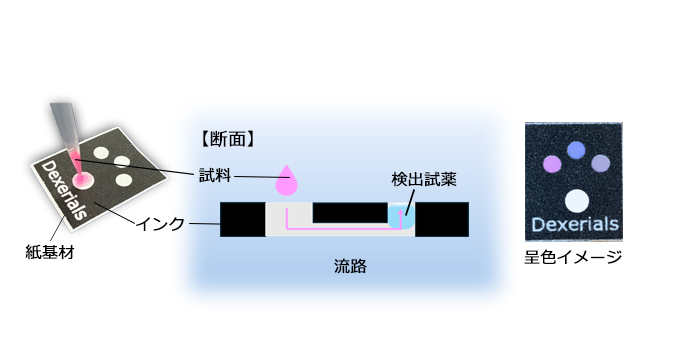
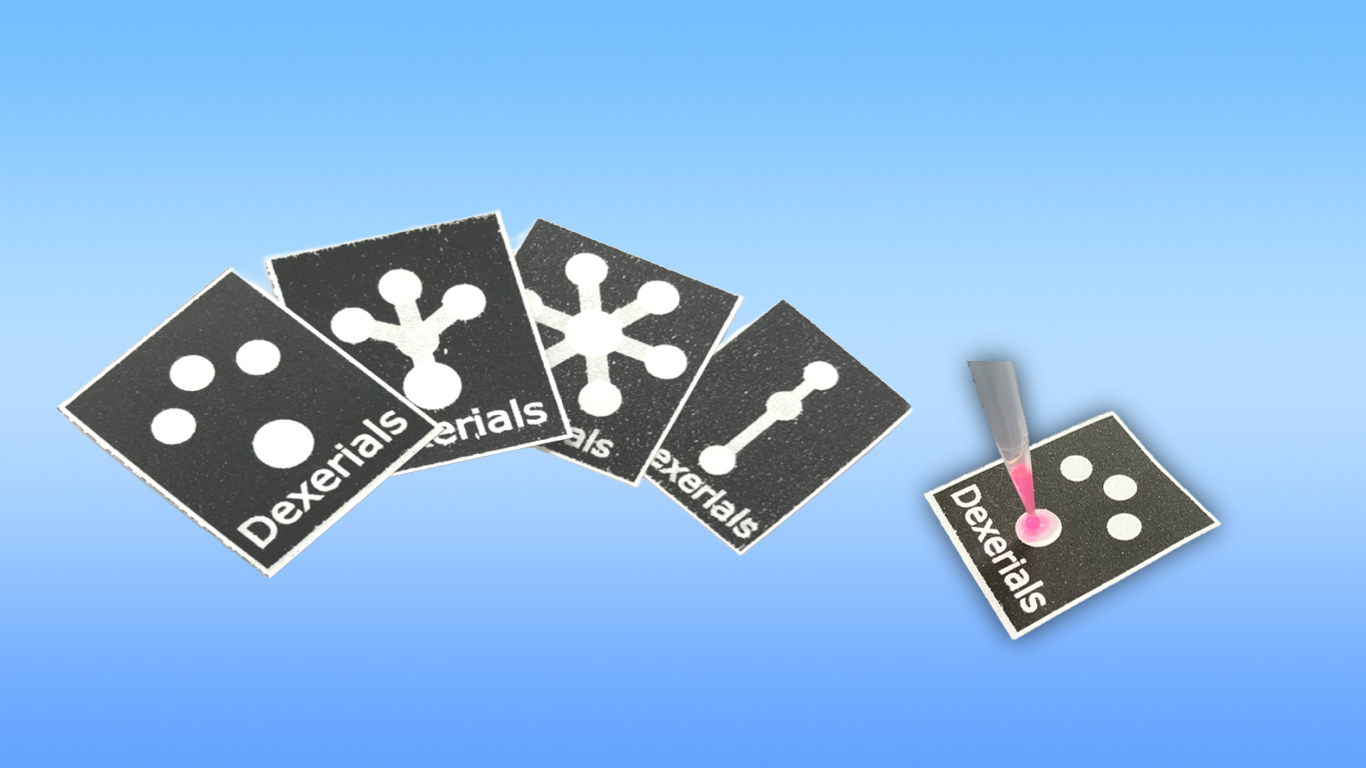
One technology gaining attention as a tool to enable POCT is μPADs (Microfluidic Paper-based Analytical Devices), which are analytical devices that use paper as their base material and belong to the category of paper-based microfluidics.
Paper fibers contain countless microscopic pores, and μPADs utilize the phenomenon in which liquids naturally move through these pores. By taking advantage of this capillary action, liquids can be controlled without the use of any external power sources such as pumps.

The main features of μPADs include the following:
- Low cost, lightweight, and disposable:The simple structure using paper substrates enables cost-effective designs suitable for single-use applications.
- Manufacturing by printing:Fluidic patterns can be formed using inkjet printing or thermal transfer technologies, making the manufacturing process simpler compared with conventional microfluidic chips.
- No power required:Because liquid movement relies on capillary action, no power supply or batteries are needed.
- Compatibility with digital diagnostics:Reaction results can be captured using a smartphone camera and analyzed quantitatively through dedicated applications.
By leveraging the properties of paper while enabling the flow path formation and reaction control required for microfluidic devices, μPADs offer a distinctive approach to analytical device design.
Application areas of μPADs: Expanding into medical, environmental, and food fields
The application scope of μPADs extends beyond medical diagnostics and into a wide range of fields. Thanks to the simplicity of paper substrates and the flexibility of flow path design, μPADs are being considered for use in the following areas:
- Medical: Diabetes-related analysis, infectious disease diagnostics, urine testing, and drug testing
- Environmental analysis: Water quality testing, heavy metal detection, and pesticide residue analysis
- Food and agriculture: Quality evaluation, analysis of food components, and pregnancy testing in livestock applications
- Education and research: Teaching materials suitable for student experiments and fieldwork
Because paper-based devices are easy to handle and can be used without specialized equipment, μPADs expand the range of environments in which analytical testing can be performed.
How μPADs are changing the development process
Conventional microfluidic chips often require semiconductor processes such as mold fabrication and photolithography. In contrast, μPADs enable relatively easy pattern formation by utilizing printing technologies.
As a result, the development cycle from prototyping to design modification can be shortened. In addition, μPADs do not require complex operations or specialized expertise, as results can be obtained simply by dropping a sample onto the device.
Furthermore, by linking with smart devices, quantitative measurement through image analysis and efficient data management become possible. This balance between simplicity and high functionality expands the potential of μPADs not only for healthcare professionals but also as self-care devices that can be used directly by patients.
Future outlook for μPADs technology
With their simple structure, ease of handling, and low cost, μPADs are being explored for applications across diverse fields, including medicine, environmental analysis, food, and education. By combining paper substrates with microfluidic technology, μPADs are expected to serve as a new development approach for POCT devices.

Dexerials is actively conducting research and development on μPADs.
The information in this article is based on the status at the time of writing. The specifications and availability of μPADs may change in the future. For the latest information, please refer to official announcements from Dexerials.
Related articles
Dexerials is a materials manufacturer that produces materials essential for the evolution of devices and next-generation solutions.
We will create new value with partners around the world in areas including electronic components, bonding materials, and optical materials.
- Share
We provide materials on our products and manufacturing technologies.
They can be downloaded for free.
Download Materials
We provide materials on our products and manufacturing technologies.
They can be downloaded for free.
Download Materials