
- Electronic Components
Electrification and Circuit Protection Design for Gardening Equipment: New Safety Challenges for Evolving Gardening Equipment

目次
- 1. Evolving gardening equipment and the changing global market
- 2. The advantages of and challenges faced by two-stroke engines
- 3. Changes in emission regulations and the market
- 4. Comparing gasoline and electric equipment: advantages and disadvantages
- 5. Current conditions and technical challenges for electric gardening equipment
- 6. Circuit protection and standards compliance in safety design
- 7. Why are SCPs chosen as circuit protection parts for gardening equipment?
Evolving gardening equipment and the changing global market
Some readers of this article may enjoy spending their free time gardening, and there is a wide variety of helpful tools and equipment to support this. In particular, gardening equipment is widely available in North America and houses with nicely maintained lawns are a common sight. The practice of residential lawn care in North America is said to have its roots in the gardens of medieval European nobles. This European garden culture spread to affluent Americans in the 18th and 19th centuries, and was adopted by President Jefferson in his Monticello home. Gardening equipment has long been used around the world as an indispensable part of outdoor work such as lawn mowing, pruning, and land leveling. Motorized gardening equipment appeared in the late 19th and early 20th century in the form of lawn mowers powered by lightweight steam engines and gasoline engines. The 1920s saw new products from various companies and the beginning of mass production, and chainsaws, power sickles, and more entered the market by the 1930s. The spread of lawn mowers and garden hoses, combined with the growing popularity of golf, made gardening accessible to the general public, leading to a new symbol of the American Dream—the swath of single-family homes with lawns seen in the post-World War II suburb of Levittown on Long Island.
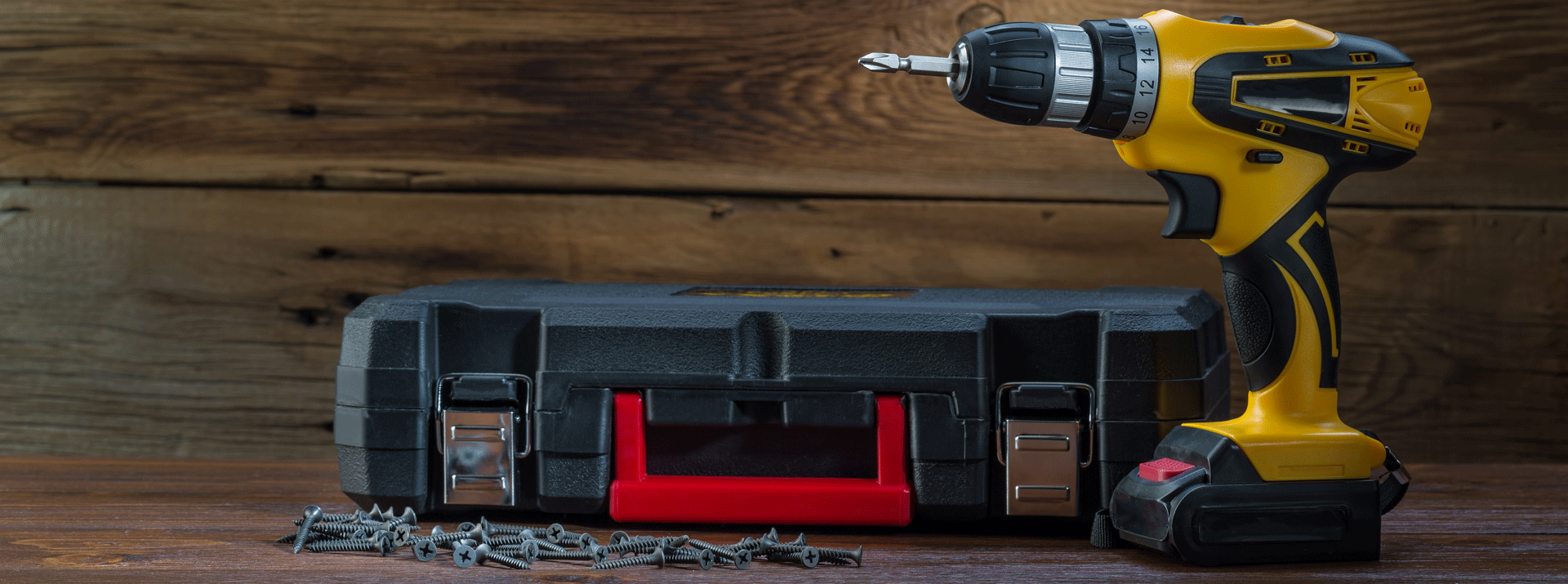
Battery-powered tools saw their start as Black & Decker developed a NiCad battery-powered cordless drill in the US in 1961. Bosch introduced a battery-powered hedge trimmer in 1969, and GE’s Elec-Trak electric tractor appeared in 1969–75, and prototype battery-powered mowers were seen in 1959–62. As battery technology evolved from nickel-cadmium to nickel-metal hydride to lithium-ion, battery-focused equipment brands emerged in the 2000s, and they are now widespread in professional use as well.
Before this, gasoline-powered equipment dominated the market, valued for its ability to deliver high power output even in large areas without access to electricity.
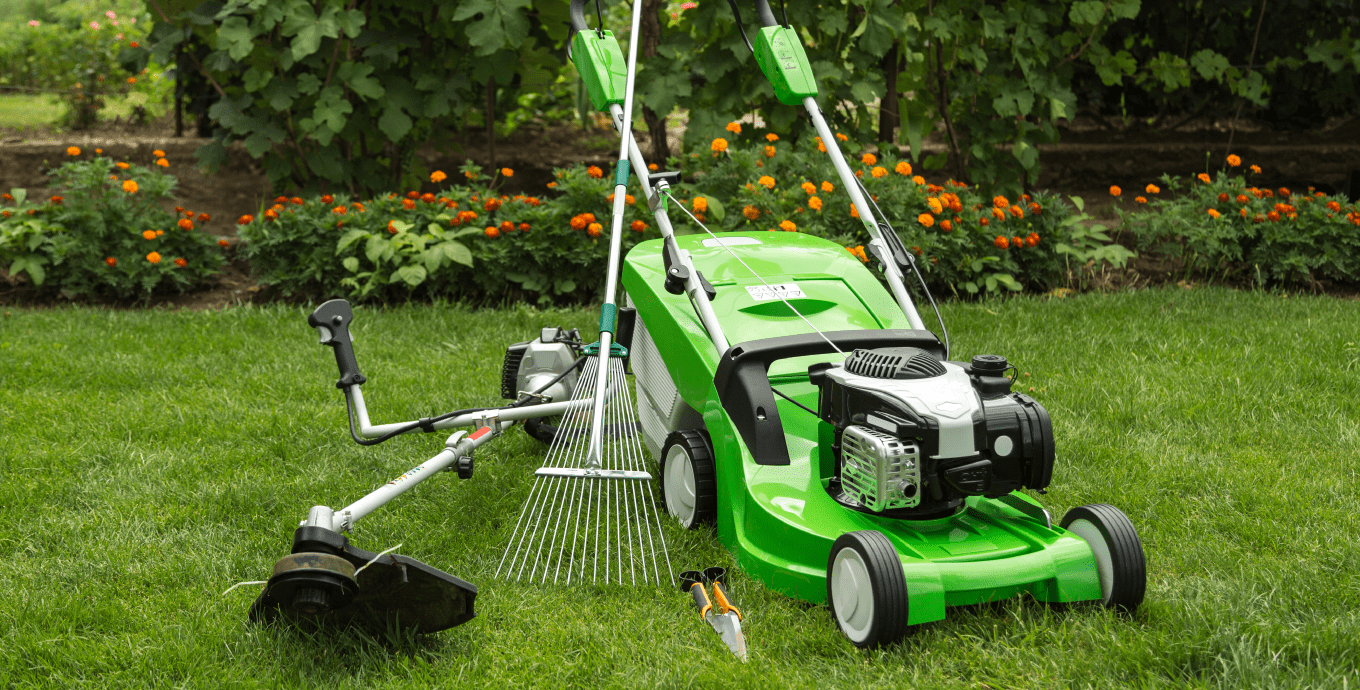
These gasoline-powered tools feature designs that emphasize portability and easy handling, and are widely used in farming and gardening in Asia, North America, and Europe. Lawn mowers, chainsaws, leaf blowers, and more are used for farming, gardening, and municipal green space management on a daily basis.
Changes in the demand for gardening equipment can be seen in the recent global market. The worldwide market for gardening equipment was approximately $102.2 billion in 2024 and is expected to reach approximately $155.9 billion in 2031 for a compound annual growth rate of 6.3%.
There are several factors behind this growth. One is the spread of residential development and green roofs in urban areas, leading to a greater need for compact equipment that can be used in home gardens and small spaces. Another factor is the growing number of DIY enthusiasts who enjoy vegetable gardens and outdoor activities, preferring electric products for ease of operation and maintenance. Finally, the evolution of smart sensors and battery technology is driving the introduction of advanced products such as robotic lawn mowers as well as higher product unit prices.
Regionally, North America has the largest market, where a strong DIY culture drives rapid adoption of electric-powered and IoT products. Asia-Pacific, on the other hand, is expected to mark the highest growth rate (7.9% CAGR) as interest in gardening grows together with urbanization and rising income levels.
As the gardening equipment market grows worldwide, change can be seen in the performance and functions that customers expect. In particular, advances in electrification are also increasing interest in circuit design, safety, and product design that considers environmental impacts such as greenhouse gas emissions. In the next chapter, we will examine the advantages of and challenges faced by the two-stroke engine, a mainstay of gasoline-powered tools.
Source: Data Bridge Market Research “Global Gardening Equipment Market – Industry Trends and Forecast to 2031”
The advantages of and challenges faced by two-stroke engines
Many gasoline-powered gardening tools are driven by two-stroke engines. These engines are often used in handheld equipment such as brush cutters and chainsaws due to advantages that include their simple structure, light weight, and high power output for the size.
A two-stroke engine completes the intake, compression, power, and exhaust phases of the combustion cycle in two strokes of the piston (one revolution), resulting in high power density per engine revolution and making it a good fit for compact tools. On the other hand, it is less fuel-efficient and tends to emit higher levels of unburned gases when compared to a four-stroke engine.
In addition, the two-stroke engine uses a mixture of oil and gasoline as fuel, requiring the user to prepare their own fuel mixture. Some level of knowledge and caution is required for regular maintenance, as an incorrect fuel ratio can lead to carbon buildup or engine seizure.
Due to issues such as exhaust emissions, difficult fuel management, and addressing environment-related performance, two-stroke engines are currently facing the challenge of compliance with environmental regulations. In particular, products intended for use in urban and residential areas now place greater emphasis on reducing noise and exhaust emissions. noise and exhaust emissions.
Changes in emission regulations and the market
One of the challenges facing two-stroke engines is environmental impact. They are structurally prone to low fuel combustion efficiency and emit unburned fuel and oil, sometimes leading to air pollution and pungent smells.
As a result, various countries have implemented increasingly strict regulations on exhaust emissions. Particular in Europe, strict environmental protection standards were put in place early and cover equipment with small engines such as gardening tools. For example, the European Union (EU) has implemented Stage V standards that establish emissions limits for nitrogen oxides (NOx) and hydrocarbons (HC).
Emission regulations for small-engine equipment such as gardening tools have become increasingly strict worldwide in recent years. In the EU, non-road mobile machinery (NRMM) regulations have defined approval procedures for engine types and established emission standards for various power ranges and purposes. (* Non-road mobile machinery – European Commission)
In the US, the Environmental Protection Agency (EPA) has set emission standards for small spark-ignition engines, rolled out in phases since 2011 and 2012. These regulations address not only exhaust emissions but evaporative fuel emissions from fuel system parts. (* Regulations for Emissions from Marine Spark-Ignition Engines | US EPA)
In response to international trends toward stronger regulations, gardening equipment manufacturers are working to optimize engine power and develop models with lower environmental impact. In addition, more companies are aggressively transitioning to higher-powered electric models.
Comparing gasoline and electric equipment: advantages and disadvantages
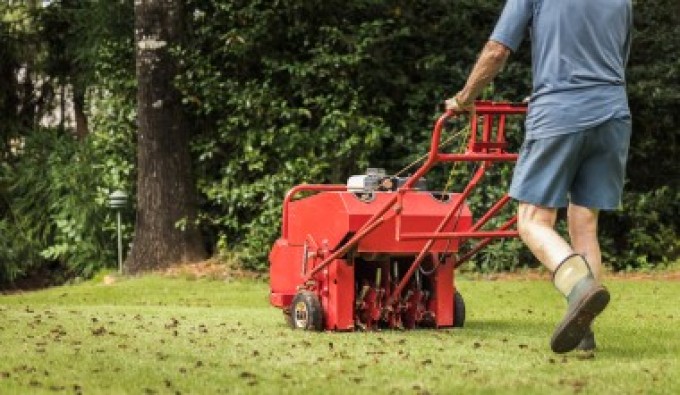
While environmental regulations and market changes are driving the electrification of gardening equipment, not all gasoline-powered equipment can be immediately replaced with an electric motor. Both gasoline and electric tools have their own advantages and disadvantages.
The biggest advantages of gas-powered equipment are their high power output and long operating times. With enough fuel, extended work sessions are possible.
On the other hand, fuel mixtures require careful handling. Oil and regular gasoline must be mixed in the correct ratio, and the fuel mixture has a limited shelf life because gasoline evaporates and deteriorates over time. Using a degraded fuel mixture will make it harder to start the engine and can lead to carburetor and fuel filter clogs. In addition, constant care is required when storing gasoline-powered tools—if poor storage conditions allow water to get into the engine, it may seize during use. Maintenance and preparation for gasoline-powered gardening equipment requires time and effort.
The advantage of electric equipment is ease of use. It can be started with the press of a button, and maintenance requires less effort. Not needing to mix fuel is also a significant plus for beginners and home gardeners.
However, battery capacity can limit work times and make high-load tasks difficult.
Gasoline and electric power each have their own advantages and disadvantages—currently, the realistic solution is often to choose the right tool for each job.
| Electric gardening equipment | Gasoline-powered gardening equipment | |
|---|---|---|
| Output and usability | Slightly inferior -not suitable for some high-load tasks | Superior -high engine displacement can clear areas of dense brush, etc. |
| Maintenance | Superior-just need to charge battery | Inferior -requires fuel mixing and fuel tank maintenance |
| Exhaust emission regilations | No issues | Compliance with emissions regulations is required |
| Run time | Short -usually up to around 1 hour even with high-capacity batteries | Long -can run for several hours on 1 liter of mixed fuel |
Current conditions and technical challenges for electric gardening equipment
While electric gardening equipment has many advantages in usability and environmental performance, the technology has not yet fully developed. Several challenges still remain, especially for high-load work and certain types of tasks.
Recent years have seen the introduction of products with high-voltage lithium-ion battery packs such as 36 V and 80 V, boosting overall power output. This increase in power output is gradually enabling the use of electric tools for tasks that once called for gasoline-powered equipment. However, high voltage alone will not make all tasks possible.
For example, cutting tree trunks and thick branches, or clearing dense, overgrown brush are high-load tasks where the output limiters in electric models can negatively impact work efficiency. Pushing the equipment to continue working can increase the risk of battery and motor overheating, so many products include safety features that automatically shut down the system to prevent damage.Limited battery capacity can also lead to the equipment running out of charge in the middle of a task and needing to switch to a backup battery.
It is important to understand that electric gardening equipment may not function optimally depending on the work environment and type of task.
Therefore, designs that ensure safety even during unexpected malfunctions are essential for user confidence.
Circuit protection and standards compliance in safety design
As gardening equipment transitions from gasoline to electricity, new challenges have emerged around electric circuit safety. When the power system of a battery-powered product malfunctions, it can create risks such as overcurrent, short circuits, overheating, and in the worst case, fire.
Designs that can reliably interrupt a circuit are required to address these risks. This is no longer a mere added value but is becoming a prerequisite for compliance with international safety standards.
For example, UL 62841-1 is a safety standard for small motor-operated equipment, including electric equipment and gardening equipment. It requires that internal circuits be physically disconnected in case of malfunction. In addition, UL 62133 and the international IEC 62133 standard define “operating conditions during normal charging (within the specified operating region)” for devices with lithium-ion batteries and require countermeasures for conditions beyond those limits.
Standards like these set conditions for cells such as the following:
- • Open circuit voltage is maintained to at least 90% of voltage before the test
- Conforms to standard charging and recharging tests
- • No damage to cell vents
In addition, standards require designs that do not ignite even if parts are broken. For example, if overcharging occurs due to a part malfunction, cell voltage must not exceed 150 mV, and if it does, recharging must be permanently disabled.
Tests such as enclosure pressure tests and mechanical strength tests evaluate whether safety is ensured after physical or electrical malfunctions, and the choice of circuit protection parts is a critical design element that directly impacts whether a product complies with standards.
In other words, protective designs must not only deliver performance during normal use conditions but also reliably disconnect when a malfunction occurs to prevent secondary damage.
Why are SCPs chosen as circuit protection parts for gardening equipment?
With the spread of electric gardening equipment, the selection of circuit protection parts to support product safety and reliability has become key during the design process. For equipment powered by high-output, high-voltage lithium-ion batteries in particular, ease of integration, and long-term reliability are required in addition to power interruption during malfunctions.
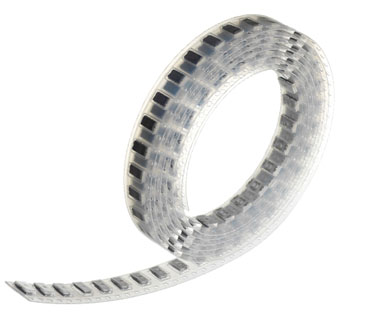
Dexerials offers Self Control Protectors (SCPs), surface mount fuses developed to address the above needs in outdoor products such as gardening equipment.
SCPs have the following characteristics:
- Permanent disconnection: physically interrupts the circuit upon malfunction
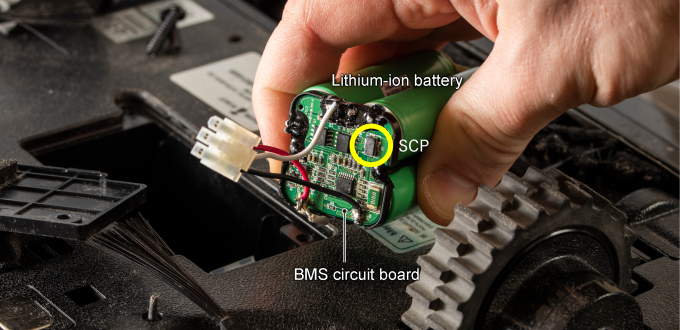
SCPs are permanent disconnect-type fuses that physically interrupt the circuit when a malfunction such as overcharging or overcurrent occurs. This prevents the use of a battery once a malfunction is detected. - Low-resistance design: supports fast charging and power efficiency
SCPs are designed to have low resistance when a current is running through it, enabling high-output operation and fast charging. More gardening tools are adding fast charging capability in recent years to improve user convenience, and SCPs are flexible enough to support these circuit designs. - Fuse melting curve control: enables full use of cell performance
SCP structures can immediately disconnect upon malfunction by activatingits internal heater. This fuse melting curve control functionality enables designs that take full advantage of cell performance regardless of fuse specifications. This makes it possible to achieve designs that safely make use of a cell’s full potential, even for tasks that involve temporary high loads.
Gardening equipment is intended for outdoor use, making them subject to various environmental stresses such as high temperatures, high humidity, vibration, impact, and dust.
SCPs are surface mount fuse elements that prevent batteries from reaching a dangerous state by ensuring the circuit is interrupted when a malfunction such as overcharging or overcurrent occurs.
Dexerials’ SCPs are used to improve the safety of gardening equipment powered by lithium-ion batteries, and demand continues to grow each year. For details on how SCPs work, please see this article: (Secondary protection element technology for high current lithium-ion batteries)
As the equipment used for gardening work transitions from gasoline to electric, there is a growing need to consider safety and address new design challenges.
Circuit protection design is essential for gardening equipment—not only to deliver high performance, but also to safely shut down operation in the event of a lithium-ion battery malfunction.
As the gardening equipment market continues growing, Dexerials’ Self Control Protector (SCP) surface mount fuses will contribute to users’ safety and peace of mind.
Reference: Japan on the Mark UL Japan
Related articles

私たちデクセリアルズはデバイスの進化に欠かせない材料や次世代のソリューションを生み出す、マテリアルメーカーです。
電子部品、接合材料、光学材料をはじめと世界中のパートナーと新しい価値を生み出していきます。
- Share
We provide materials on our products and manufacturing technologies.
They can be downloaded for free.
Download Materials関連製品
Related articles
Popular Articles for Electronic Components








We provide materials on our products and manufacturing technologies.
They can be downloaded for free.
Download Materials